Token-based security
Token-based security restricts access to your stream by requiring a valid JWT (JSON Web Token) on every playback request. This ensures that only authenticated viewers — those who have received a token from your backend — can access the stream.
How it works
When token security is enabled on a distribution, the CDN validates the JWT on each request. The token is signed with a shared secret (HS256/HS512) or a public/private key pair (RS256/RS512) that you provide when enabling the feature.
The token can be provided in one of two ways:
-
As an
Authorizationheader with a Bearer token:Authorization: Bearer <JWT> -
As a
tokenquery parameter:?token=<JWT>
The token payload must include:
exp— expiration time in epoch format. The token is rejected after this time.nbf(optional) — "not before" time in epoch format. The token is rejected before this time.
Additionally, the following standard optional claims are supported:
| Claim | Type | Description |
|---|---|---|
sub | string | Subject. If present, a SHA-256 hash of this value is used as the viewer identity. |
iss | string | Issuer. Identifies the system that created the token. |
Requests without a valid token are rejected. If the distribution does not have token security enabled, the Authorization header is ignored.
Custom claims
The optiview claim
The JWT token supports a custom optiview claim that enables fine-grained access control. When present, the claim restricts token usage based on channel, geography, or device type.
| Property | Type | Description |
|---|---|---|
ch | string[] | Channel ID(s). If present, the token can exclusively be used for a channel in this list. |
cc | string[] | Country code(s) in ISO 3166-1 alpha-2 format (e.g. "US", "BE"). If present, the token can exclusively be used for a country in this list. |
rgn | string[] | Region code(s) using the subdivision codes defined in ISO 3166-2, only supported for US regions (e.g. "US-CA", "US-NY"). If present, the token can exclusively be used for a region in this list. If the viewer's region cannot be determined, the request is denied. |
hw | string[] | Device type(s). If present, the token can exclusively be used by a device type in this list. Possible values: "desktop", "mobile", "tv". If the viewer's device type cannot be determined, this restriction is skipped. |
tid | string | Tracking ID. A group identifier string used to correlate viewers. |
cvd | string | Custom viewer data. Arbitrary string attached to the session, e.g. an individual identifier to uniquely identify a viewer. |
All properties are optional. When a property is omitted, no restriction is applied for that dimension.
Device type mapping
The hw device types are derived from the viewer's User-Agent header:
| Detected device | Mapped type |
|---|---|
| Desktop / Media player | desktop |
| Smart Phone / Tablet | mobile |
| Smart TV / Game console | tv |
Example payload:
{
  "sub": "user-12345",
  "iat": 1516239022,
  "exp": 1672531200,
  "optiview": {
    "ch": ["channel_1", "channel_2"],
    "cc": ["US", "BE"],
    "rgn": ["US-CA", "US-NY"],
    "hw": ["mobile", "tv"],
    "tid": "group-abc",
    "cvd": "viewer-98765"
  }
}
Configuration
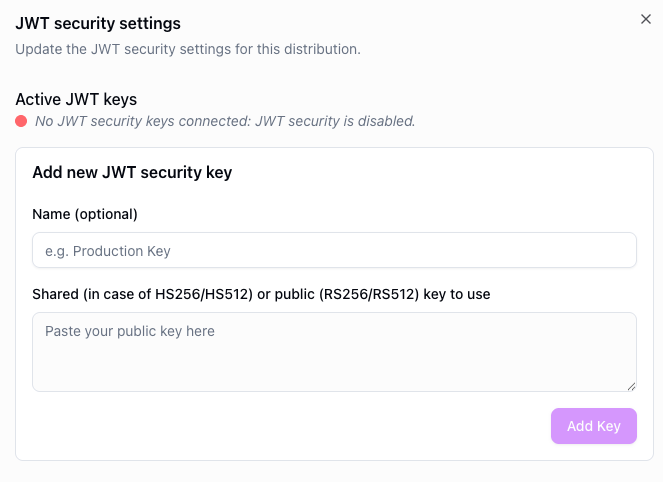
To enable token-based security, navigate to your distribution's security settings and enable the token security toggle. Provide the shared secret or public key used to verify tokens.
Supported signing algorithms
| Algorithm family | Key type | Description |
|---|---|---|
| HS256 / HS512 | HMAC (symmetric) | Signed with a shared secret. |
| RS256 / RS512 | RSA (asymmetric) | Signed with a public/private key pair. |
Player configuration
The player needs to be configured to pass the token with each request. Refer to the platform-specific guides: